Straining in the litter box looks the same whether your cat is constipated or blocked, and from across the room there is no reliable way to tell them apart. The difference is that a blocked cat, most often a male, cannot pass urine at all, which is an emergency from the moment you suspect it. Potassium and waste build up quickly once the urethra is blocked, and your cat can go from uncomfortable to critical in a matter of hours. Blockage is one piece of feline lower urinary tract disease, or FLUTD, the umbrella term for the bladder and urethra problems behind this kind of straining, and most cases respond well when they are caught early.
Not knowing whether your cat is miserable or in real danger is frightening, and sorting that out is the first thing we do. Cane Bay Veterinary Clinic in Summerville can examine your cat's bladder and use urine testing and imaging to tell a blockage from constipation, because the answer changes what has to happen next and how quickly. Stress is one of the biggest drivers of feline urinary disease, so we built our practice around Fear Free care, from the calming pheromones in the building to gentle handling when your cat already feels terrible. If your cat is straining, crying in the litter box, or coming away with nothing, that is an emergency: call us right away, and if we are closed, go straight to the nearest 24-hour veterinary hospital rather than waiting for morning.
If Your Cat Is Straining Right Now, Start Here
- A cat who strains and produces nothing may be blocked, and that's an emergency measured in hours, not days.
- Constipation and a blockage look almost identical from across the room. A straining cat needs an exam, not a guess at home.
- Most urinary cases in cats under 10 are sterile inflammation. An antibiotic often isn't the answer, and stress reduction usually is.
- Water, litter box setup, and a calm routine do more to prevent the next episode than anything you can buy.
Is Your Cat Straining in the Litter Box, or Is Something Worse Going On?
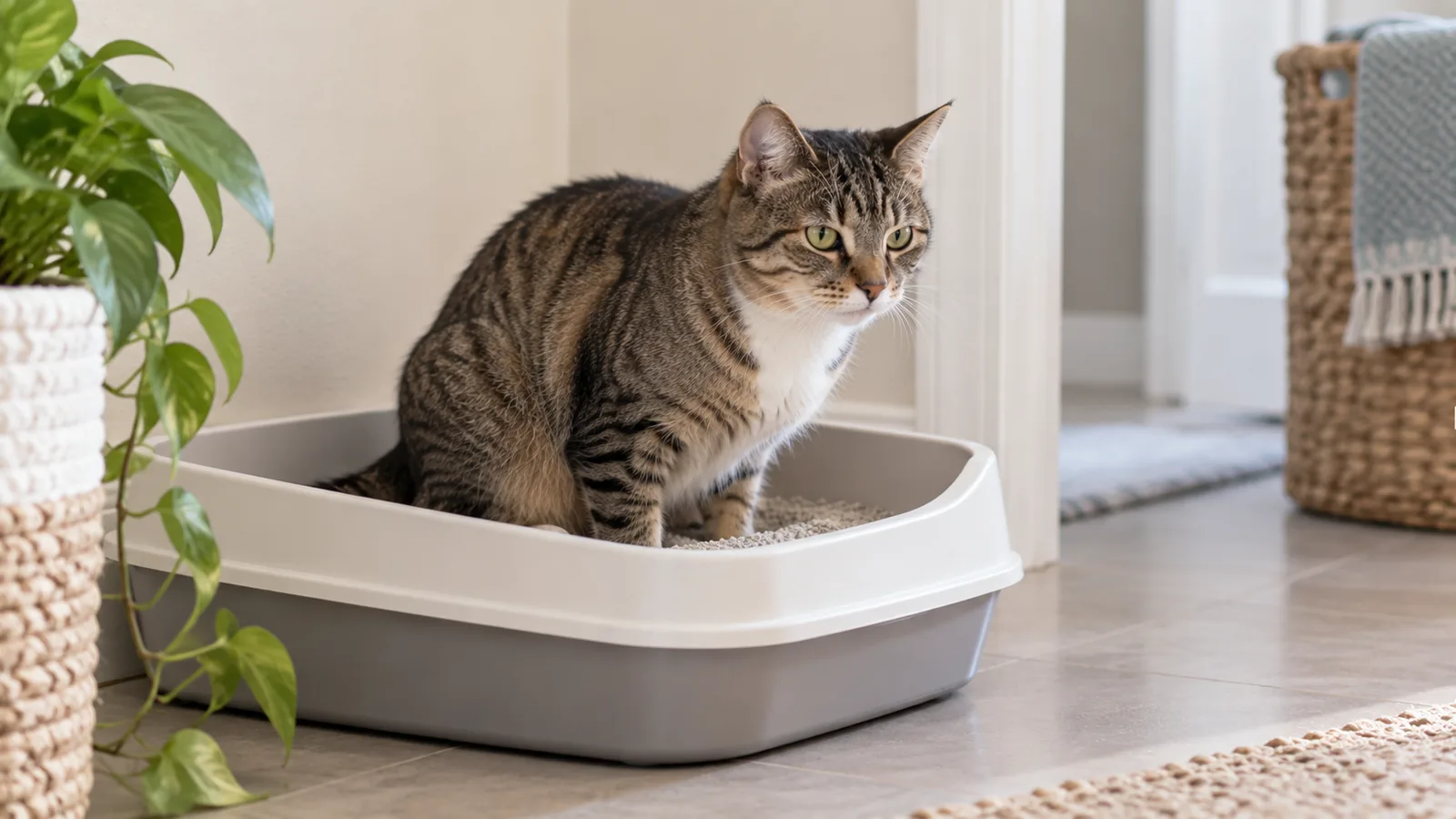
Straining is the sign that brings most cats in, and from across the room a blocked cat and a constipated cat look nearly the same. Both hunch, both cry, both make trip after trip. What separates them is whether urine comes out, and that one detail decides whether this is an emergency or something we can sort out at a regular visit.
You often can't tell by watching. Families arrive certain their cat is backed up and learn the bladder is full and the urethra is plugged, and the reverse happens just as often. If you aren't sure which one you're looking at, that's a question for one of our veterinarians, to be answered with an exam and lab work.
| A cat who's blocked | A cat who's constipated | |
| In the box | Straining hard, producing a few drops or nothing at all | Straining hard over stool, with urine that still looks normal |
| How they act | Restless, crying, licking under the tail, vomiting and hiding as the hours pass | Sore and off food, but usually steadier hour to hour |
| What it needs | Emergency care the moment you suspect it | An exam and a plan, not a wait-and-see week |
The signs that come before a crisis are the ones worth knowing:
- More trips, less urine: a cat in and out of the box every few minutes isn't being fussy about the litter.
- Blood in the urine: pink-tinged clumps or a rusty tint on the litter counts.
- Crying or holding the posture: vocalizing in the box, or staying hunched long after a comfortable cat would have wandered off.
- Licking under the tail: repeated grooming there usually means irritation.
- Peeing outside the box: a cat who starts using the bath mat or the tub is often telling you that using the litter box hurts.
What Is FLUTD, and Which Cats Are Most Likely to Get It?
Feline lower urinary tract disease is not one diagnosis but a group of conditions affecting the bladder and urethra, and it turns up most often in indoor cats, overweight cats, and cats in the middle years, though a thin young cat can land in the exam room with the same signs.
Indoor life raises the odds mostly because of what comes with it, such as a drier diet, less movement, a shared box, and a smaller world where one change lands hard. Male anatomy adds a second layer of risk: the urethra narrows toward the tip, giving a male cat a place for debris to lodge that a female doesn't. Females still get every other form of this disease at the same rates. Kittens rarely block, and young to middle-aged adults are the patients we see most.
What Causes a Cat's Bladder to Act Up in the First Place?
Four things drive most cases: inflammation, stones, a urethral plug, and infection. The most common cause of urinary signs in cats under 10 is feline idiopathic cystitis, bladder inflammation with no infection and no stone behind it, and episodes tend to follow a change in the household: a move, a houseguest, a new pet, a schedule that shifted.
Idiopathic means we can't point at a single cause, but the pattern holds up: stress hormones irritate the bladder lining, the lining gets sore, pain makes the cat tense, and the cycle feeds itself. That's why calming the household does as much work as anything we dispense.
Urinary stones form when minerals crystallize out of urine that is too concentrated, and the type matters, because struvite often dissolves with a prescription diet while calcium oxalate has to come out. A urethral plug is different again, a paste of crystals, mucus, and cells that wedges into that narrow male passage and turns a painful bladder into a true emergency. True bacterial disease rounds out the list and is far less common in young cats than most families expect.
How Do We Find Out What's Behind the Straining?
The workup starts with urine, and our in-house lab means the sample doesn't have to travel anywhere before we can read it. A urinalysis reads concentration, pH, crystals, blood, and cells, which separates sterile irritation from stones from bacteria. Bloodwork follows for any cat who seems ill or may be obstructed, and imaging comes next when mineral or anatomy is in question.
A culture is what separates sterile inflammation from a true bacterial urinary tract infection, which is uncommon in young cats and far more likely in cats over 10 or cats already managing kidney disease or diabetes. Those samples go to a reference lab, and the result decides whether an antibiotic belongs in the plan at all.
For a cat who may be obstructed, blood values tell us how far the kidneys and potassium have drifted, and an EKG tells us whether the heart is feeling it yet. Not every stone shows up on a radiograph. That's why digital X-rays and ultrasound work as a pair: one finds mineral, the other reads the bladder wall and the kidneys behind it.
What Happens When a Cat Can't Pee at All?
A male cat who strains in the box and produces nothing may have a urethral obstruction, also called a blockage, and a complete blockage becomes fatal within roughly 24 to 48 hours as potassium climbs and the kidneys shut down. There's no version of this that safely waits until tomorrow.
Three things to skip at home, all of them tried with good intentions. Never press or squeeze your cat's abdomen to force urine out, because an over-full bladder can tear. Never give a store-bought phosphate enema for suspected constipation; those are toxic to cats, even when the problem really does turn out to be stool. And keep the medicine cabinet closed: a single acetaminophen or ibuprofen tablet is enough to poison a cat, and there is no safe human painkiller to reach for.
Care for a blocked cat moves quickly. Bloodwork and an EKG come first, IV fluids go in to flush potassium and protect the kidneys, and relieving the obstruction means sedation and a urinary catheter to open the urethra and empty the bladder. From there it's usually a few days of fluids and monitoring, then a recheck to confirm your cat is emptying on their own once the catheter is out.
If you suspect this on a weekday, call or text us right away and let us know your cat is on the way to Summerville. A cat who blocks overnight or on a weekend needs the nearest 24-hour emergency hospital instead, and that drive is the right call, not an overreaction.
How Is FLUTD Treated Once We Know What We're Dealing With?
What the workup turned up sets the plan, and most cats go home with pain relief, a therapeutic diet, more water, and changes at the litter box rather than a bottle of antibiotics. Surgery enters the conversation only for cats who block more than once.
| What the workup found | What treatment usually looks like |
| Idiopathic cystitis | Pain medication, stress reduction at home, and more moisture in the diet, with signs easing over days to a couple of weeks |
| Struvite crystals or stones | A prescription diet that dissolves them, plus repeat imaging to confirm they're gone |
| Calcium oxalate stones | Removal, since diet won't dissolve this type, followed by a diet aimed at preventing the next one |
| Bacterial infection | An antibiotic chosen by culture rather than by guess, with a follow-up urine sample afterward |
| Urethral blockage | Stabilization, a urinary catheter, fluids, hospital monitoring, then a long-term prevention plan |
Pain control is the piece families sometimes think is optional, and it's the piece that changes how fast a cat turns the corner. Buprenorphine and gabapentin both come up often, and gabapentin does double duty by taking the edge off the anxiety that started the flare.
Cats who block once are usually managed medically, but a cat who blocks again may be a candidate for perineal urethrostomy, a surgery that widens the narrow end of the urethra so crystals and plugs pass through instead of lodging. This surgery doesn’t fix the bladder inflammation that comes from FLTUD, but it does decrease their odds of blocking again.
What Can You Change at Home to Prevent the Next Flare-Up?
Most of what keeps a cat out of trouble happens between visits: water in more forms, boxes in more places, and a household that stays predictable. Stress and concentrated urine are the two levers you control directly.
Lowering the stress, and giving your cat something to do
Cats notice life stressors we barely register: a strange cat sitting outside the window, a litter box moved one room over, a feeding time that slid by two hours. Those small disruptions precede a surprising number of flare-ups. Start with the box math: one per cat plus one, in different rooms, uncovered, scooped daily, away from the washing machine that kicks on at odd hours. Pheromone diffusers like Feliway help fill the house with a synthetic “happy hormone” that can help lower your cat’s stress levels.
Then add height and interest. Vertical space, such as a cat tree, a cleared shelf, or a window perch, gives a nervous cat somewhere to retreat that isn't under the bed. A catnip or silvervine toy, a fresh cardboard scratcher, a grocery bag that smells like outside, and a toilet paper tube stuffed with a portion of dinner all count as enrichment toys, and most cats work harder for those than for anything that came off a shelf. Ten minutes of wand play before dinner burns more tension than an hour of anything passive.
Fear-Free handling here keeps a sore cat from learning that the carrier means pain, which matters for a patient we may need to see again.
What goes in the bowl, and why it matters so much
The question of wet or dry food carries more weight for a urinary patient than for the average cat, since canned diets run about 70 to 80 percent water and dilute the urine without your cat ever visiting the water bowl more often. Therapeutic urinary diets go further by balancing magnesium and phosphorus, leaving crystals less to build from.
Wide shallow bowls placed away from the food, a running fountain, and warm water stirred into canned food all nudge intake up. A splash of water from a tuna can or low-sodium chicken broth in the bowl can entice cats to drink more. Change food gradually over a week or so, because a cat who refuses the new diet isn't on it at all, and consistency is where the benefit lives: one diet, and treats that don't quietly undo it.
Rechecks and exams for a cat with a urinary history
Adult cats do best with wellness exams every six months, and for a cat who has had one episode, that visit should carry a behavior discussion, urine sample, bloodwork for checking kidney health, and a weight check alongside the usual. Weight creep and rising urine concentration both tend to precede the next flare, and both are easy to catch while your cat still feels fine. If old signs reappear, call rather than wait out the weekend.
Frequently Asked Questions About FLUTD
Can female cats get blocked, or does that only happen to males?
Blockage is much less common in females. Their urethra is shorter and wider, and plugs and small crystals tend to pass. Less common isn't never, though. A stone, a mass, or heavy inflammation can obstruct a female cat, and females develop cystitis, stones, and infections at the same rate males do. Any cat straining in the box without producing urine deserves an exam that day, regardless of sex.
My cat has started peeing on the bath mat. Is that behavioral or medical?
Check the medical side first, every time. Urinating outside the box is one of the most common ways urinary disease presents, because a cat who feels pain in the box blames the box and goes looking for somewhere cool and smooth. A urinalysis settles the question quickly. If the urine is clean, then litter type, box location, cleaning frequency, and household tension become the conversation, and those are solvable too.
Will my cat go through this again?
Recurrence is common with idiopathic cystitis, most often within the first year. That number drops with moisture in the diet, a calmer routine, and box changes that stick. Cats who have blocked once carry a higher risk of blocking again, and that's the reason prevention gets serious attention after the first event. Many cats never have a second episode once the pieces at home line up.
Helping Your Cat Feel Comfortable in the Litter Box Again
Most cats come through a FLUTD episode well, and plenty never have a second one once the plan at home takes hold. For a cat who's been through this before, staying current with preventive care catches the next flare while it's still small. If your cat is straining now, or has a urinary history you'd like to stop repeating, request an appointment with Cane Bay Veterinary Clinic in Summerville.